


Tending to Tendons
- kate Brown
- Mar 21
- 6 min read

There's nothing like having a tendon strain to prompt a deep dive into how we can keep our tendons in good shape. It's been 5 months since an ill timed dance with a skipping rope over stressed one of my hamstring tendons and I'm still rehabbing, all be it late stage rehab. I've learnt some really useful things during my recovery journey, hence this blog. Hopefully the tips here will help you keep your tendons in tip top shape or if damaged you can speed up your recovery. I couldn't find stats. for the prevalence of hamstring tendon strains in women but I reckon its pretty high, especially amongst those of us who love yoga. Women tend to do more high flexibility stuff than men and tendons do take stretching well. The principles outlined below do however relate to all tendons.
First what are we talking about? A tendon is a dense band of fibrous connective tissue that links muscle to bone with limited elasticity. They are primarily composed of collagen fibres and since we know collagen levels decline as we age its not surprising that there is an uptick in tendon strains in the over 50s. Tendons help muscles to transmit force, absorb impact and along with ligaments help provide stability to joints. They don't have a rich blood supply the way muscle does. Instead they rely on mechanical load to drive the cellular activity that leads to repair. So when you rest there's no signal to remodel and heal. Had I torn my tendon near the bone then I would have been looking at 12 months recovery instead of the typical 5 months for a tear closer to the muscle attachment point.
So how can you make your tendons resilient to tears and strains?
LOAD - tendons like load. Even when injured some stimulation is necessary to promote recovery. Just icing and resting will NOT help. Sure in the acute phase, just after you've injured giving a tendon some rest maybe necessary to avoid worsening the situation but not necessarily. Once that initial highly inflammatory stage has passed you need to carefully, progressively, load the tendon and get it accustomed to pulling its weight again.
The following are the sources of information and advice I found most useful.
First up is Brodie Sharpe and his podcast. Brodie has dedicated his professional physiotherapy practice into helping those with hamstring tendinopathy. He explains the latest research, answers common questions and interviews experts.
This is were I first came across the notion that rehab can be personalised according to a pain rating scale. Rehab. exercises should produce no more discomfort or pain than 3 out of 10 during the activity or immediately afterwards, and subside to base line of 0-2 out of 10 within 24hrs. If it hasn't settled down within that 24hr period you know you did too much and need to adjust volume, intensity or modify the exercise. With this guiding rule I've been able to rehab as quickly as possible. My natural tendency is to over-do-it so in the early days I endured 4 out of 10 pain, but now that I'm 90% healed its easier to adhere to. a lower threshold. The main point here is to avoid stuff that continues to agitate the tendon too much. Easier said than done when bending to put shoes on and off can hurt.
Then there's Professor Keith Barr's research. He reminded me that isometric exercises are golden when it comes to tendons. An isometric exercise is simply one in which the muscles neither shorten or lengthen but still contract. I think every therapist starts prescribing isometrics first in any rehab. programme. But what I learnt that was news to me was just how valuable isometric exercises can be for healthy tissues too and that doing isometrics can have an analgesic effect when in pain. I started pushing my heel against the floor of the car during long drives when my compressed tendon grumbled. This alongside squeezing a buttock to create a muscular pillow for the tendon, thereby reducing the tendon compression. It works!
You can listen to Tim Ferris interviewing Keith here https://tim.blog/2025/02/26/dr-keith-baar/
It's a lengthy podcast and goes into a fair bit of technical info but Keith's knowledge and passion for his subject makes it a worthy listen.
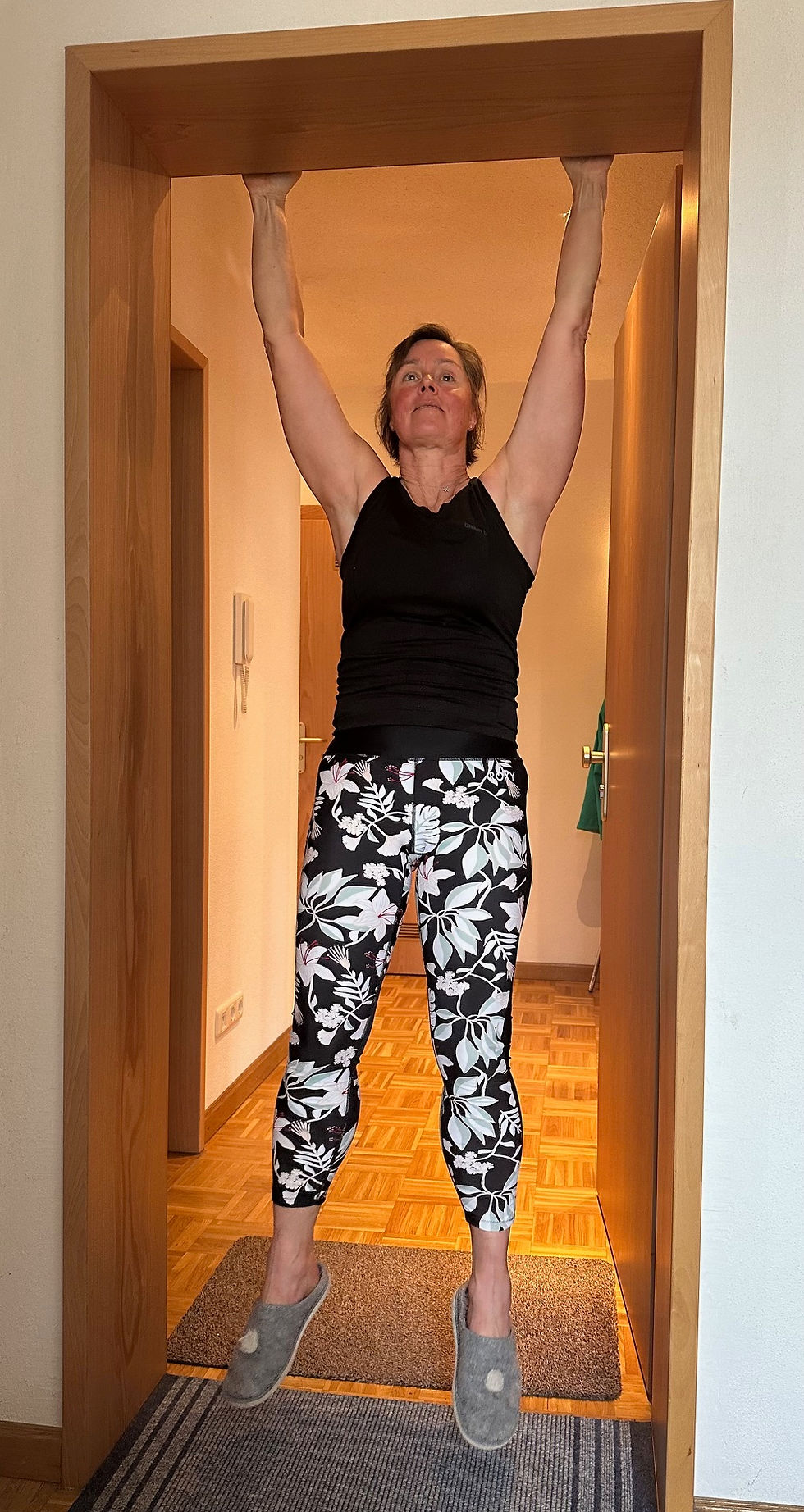
It kicks off with a discussion about Emil Abrahamsson's hangboard training for climbing. https://www.youtube.com/watch?v=3FNZdixeuZw He massively improved his strength in 10 mins a day for 30 days with still keeping his toes on the ground. Basically he had about 40% of his body weight and pulled down for 10 seconds at a time, twice a day. It worked because the limiter for many climbers is the strength in the small tendons in fingers. By deliberately targeting these structures he was able to make the most use of the stronger muscles instead of fatigue in the small structures being the limiting factor. Emil then went onto compete in hand grip contests setting new world records and beating men twice his size.
Even if you aren't a climber using a doorframe to pull down keeping toes on the ground is not only accessible to lots of people but also helps keep all the tendons from fingers through to those that help stabilise the shoulder blade healthy. and because it's fairly quite mild it's hard to over do it. Ideally varying how much the arms are bent is useful so that you train the tendons in short and long lengths. Those of you who've read my bones blog will know that hanging is good for your bones too.
Some of the other key nuggets I got from listening to the Tim Ferris interview include:
Lots of specific exercises to combat elbow issues.
-Isometric exercises trump eccentric (where the muscle lengthens under load). Its time under tension which is important. So if you lengthen slowly you will get similar gains but not as good as the more static isometrics where velocity is zero.
-Tendons can handle about 10 mins of work before needing 8hrs recovery. So you don't need tons of time, but you CAN do the exercises every day. This is similar to the brief stimulus that works best for bones too. After 10 mins of work the signal to adapt turns off so more is not better.
-healthy tendons only need 10 seconds of load/work for 2 mins of rest (4 sets is optimal). The aim is maximum signal to adapt minimum wear and tear. It's quite a mind shift if you normally buy into no pain no gain
-injured tendons, especially chronically injured ones, need 30 seconds of loading/work with 2 mins recovery. (again 4-5 sets is optimal) Bigger tendons need slightly longer than tiny tendons
-If you have an injured tendon pain should be no more than 2 out of 10, just enough that the area being loaded feels the tension, may become warm but no 'pointy', sharp pain.
-collagen from the skin of animals with vitamin C before the exercise may give 2-3% extra help, but only if you do the exercises. 30 mins before the exercise is optimal
-if you do only 1 exercise make it a split squat hold for the most bang for your effort since multiple tendons will get loaded and stronger as a result. Here's what that looks like

-some medications may improve tendons by making them bigger and stronger. SAK-STAT inhibitors used for rheumatoid arthritis and psoriasis
-other medications weaken tendons. The antibiotics Ciproflaxin and Fluoroquinolone, also Sartan drugs used for blood pressure
-moving super heavy weight, fast creates more 'jerk' in the tendon and is more risky than low velocity work. So if your sport require quick force like hitting balls, or rapidly changing direction then strong resilient tendons is absolutely essential.
-machines in gyms are kinder to tendons than free weights so opt for those if you know you are at greater risk of a strain.
-scraping maybe effective but not because it breaks up scar tissue more because it degrades healthy tissue reducing the guarding that healthy tissue does so when you exercise more load goes into the weaker structures making them stronger.
-overcoming isometrics where you are pushing or pulling against an immoveable object are better than yielding isometrics in which you are just holding a position e.g. planks
Aiden Rich's PHD research paper specifically on the proximal hamstring tendinopathy details the 5 stages of recovery
and in conjunction with Brodies work gives a route map for those of us who don't have direct access to specialists. I doubt anyone goes seamlessly through the stages but it is useful to know which exercises fit each stage. I'm currently somewhere in the last stage but still find the isometric exercises really useful in my own rehab. Indeed the final recommendation in the paper is to cycle through the different stages with 1 day doing stage 2 for instance and the next day stage 3, 3rd day back to isometrics in stage 1.
Also checkout https://www.pogophysio.com.au/blog/how-to-rehabilitate-proximal-hamstring-tendinopathy/ for more useful rehab hamstring exercises to try alongside minimising prolonged sitting on hard surfaces and avoiding stretching. These go beyond the basic isometric ones.
Get in touch if you would like to see some more routines involving isometric exercises.


Incredibly informative. I love the simplicity of achieving real gains from the doorhangs!